Galley Kitchens: Pros, Cons, and Tips
Thinking of a galley kitchen design for your renovation? Here we explore the pros and cons of galley kitchens and the possible ways to make the most of it.
The galley kitchen is a tried and tested, ever-popular layout suited to small apartments and houses. However, you don’t have to have a small space to benefit from the galley kitchen configuration. It can also be used in large kitchens or open plan layouts. This article explores the pros and cons of galley kitchens and the various ways to make the best of their potential.
What is a galley kitchen?
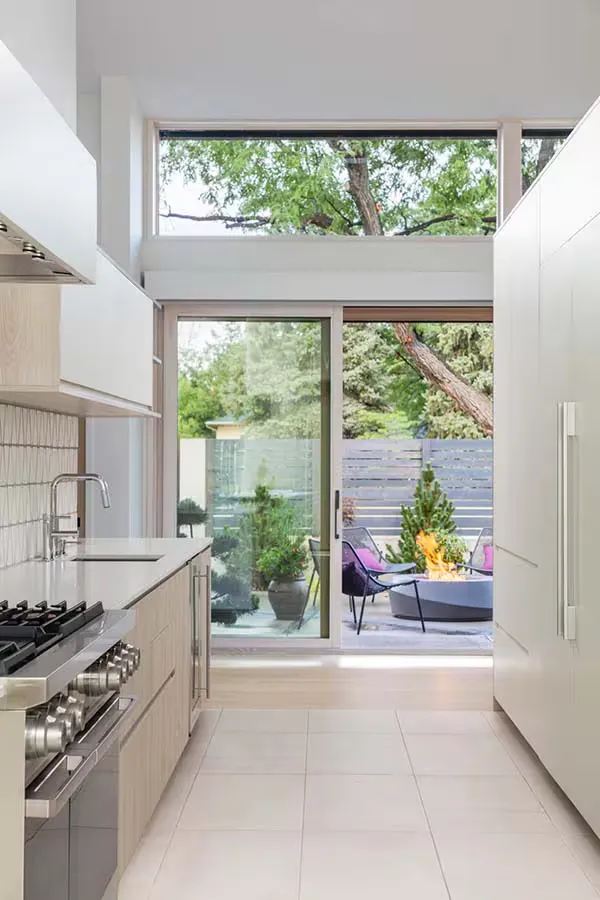
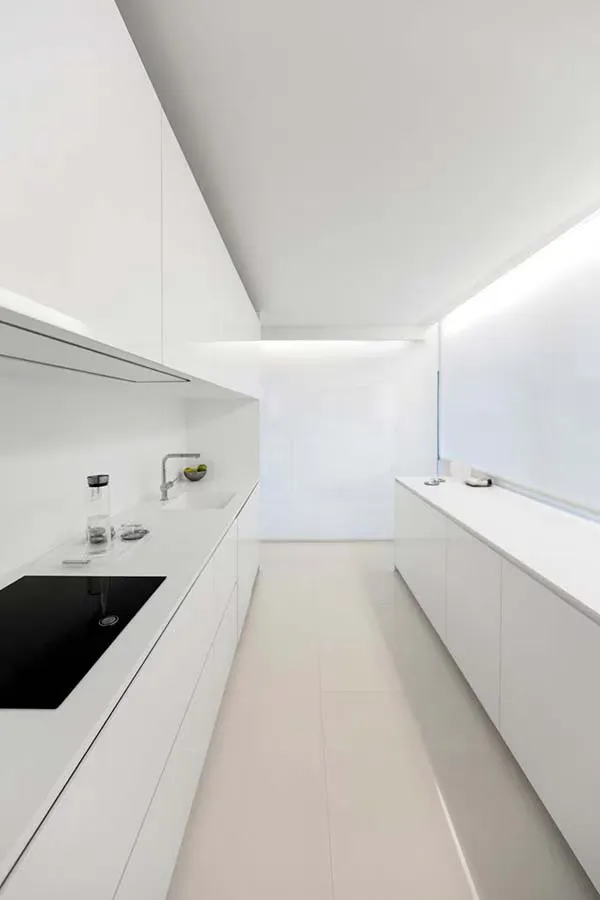
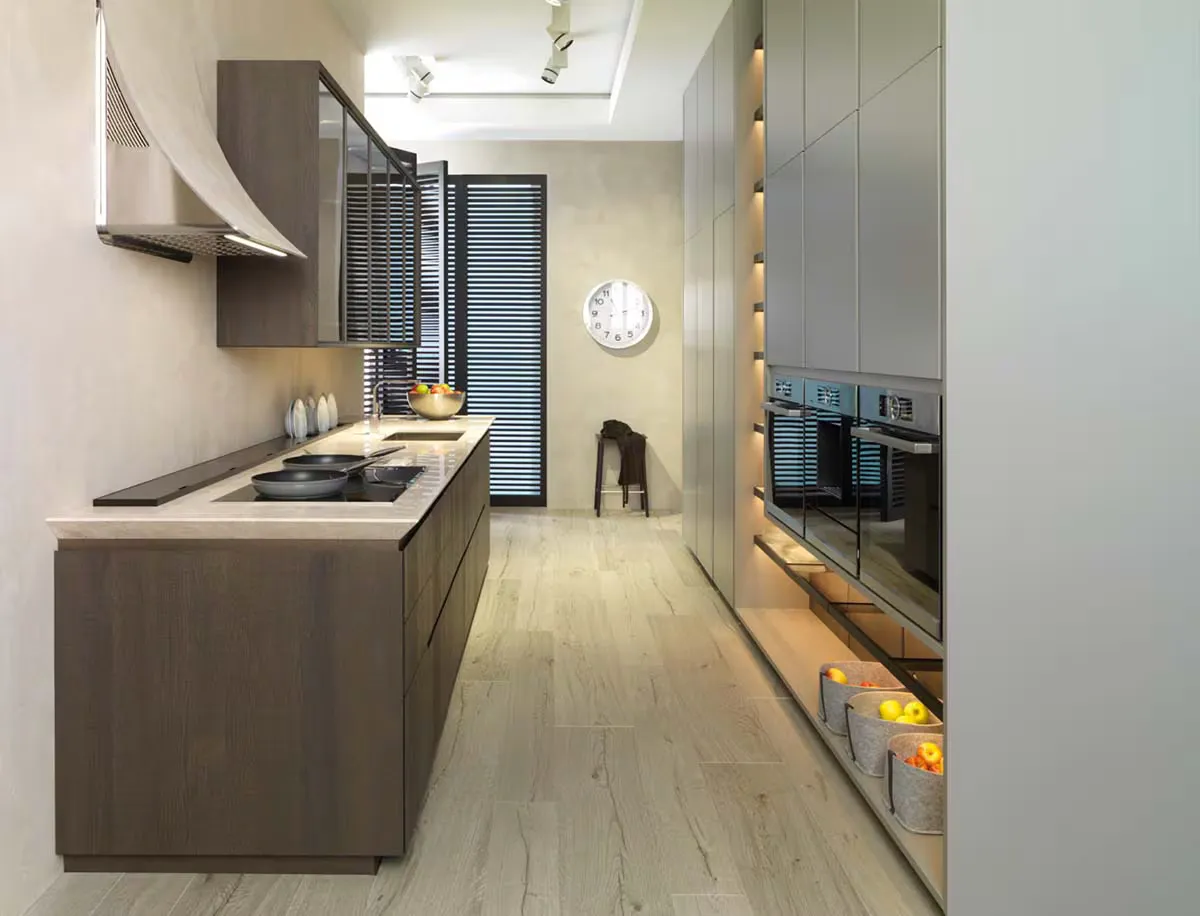
The galley kitchen describes a configuration that features two linear stretches of appliances, cabinets and worktops facing one another. Essentially, forming a corridor that must be wide enough for cabinet and appliance doors to open freely. That’s why the galley kitchen is sometimes called a ‘corridor’ kitchen.
Typically, there is access at either end of the galley kitchen, rather than a wall or other obstacle at one end. The only exception would be a window to an external wall providing natural light.
Make the kitchen of your dreams come true with our specialist advisory service.
How did the galley kitchen become popular?
The word ‘galley’ refers to the kitchens of historical ships used for trading and warfare. Today, the term encompasses the kitchens of aeroplanes and trains; any compromised space where food is prepared. Given that, traditionally, and today in contemporary restaurants, the galley kitchen caters for scores of people, its design must be optimum.
The room we know today as the kitchen first became popular in UK houses during the first decades of the 20th Century. Resembling the pantries or sculleries of larger, grander houses, but planned around a single person with mod cons like running water and gas cookers. The kitchen layout we know today emerged around the 1950s, with the introduction of the fridge freezer.
More kitchen in less space
The average size of the UK home is just under 729 sq. ft. (68 sq.m.), smaller than the average European home, so being clever with the use of space is key to home décor.
The galley kitchen is typically a separate room, but it can be incorporated into a larger space. It’s all about careful planning and efficiency in the galley kitchen. Doing more with less is what efficient design entails.
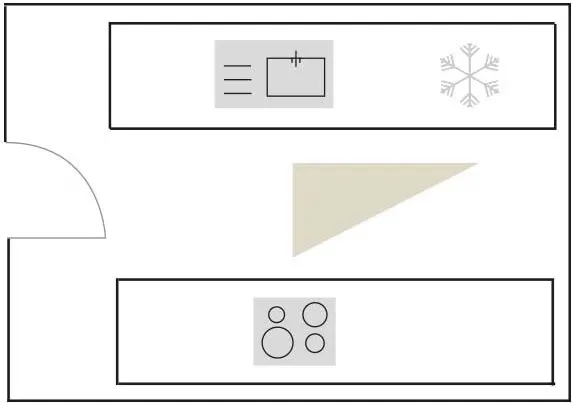
The contemporary kitchen is based on the work triangle, the relationship between cooking, cleaning and storing food. In other words: the space between the hob, the sink and the fridge. This concept is reflected in the galley kitchen, which perfectly satisfies this layout.
The Pros and Cons of the galley kitchen
As the number of people per household continues to decline in the UK, the galley kitchen has increased in popularity. More and more people are either living alone or in smaller family units. The traditional galley kitchen is the best choice for single occupancy or smaller households. But what are its pros and cons?
☑ Pros of the galley kitchen
- Of all the typical kitchen layouts, the galley is the most efficient in terms of making the most of available space.
- The recommended work triangle can be easily achieved. The galley kitchen is comfortable to prepare, cook and store food.
- Everything you need is within easy reach.
- There’s plenty of worktop space for chopping, cleaning, storing etc.
- There can be considerable cost savings with the galley layout. Not just because the kitchen is smaller but also because it is less on ‘display’.
☒ Cons of the galley kitchen
- Not every home is suitable for a galley kitchen. The configuration is best suited to corridor type spaces (long and narrow), which might not be available or desirable in your home layout.
- The galley kitchen can be claustrophobic, especially if there are wall cabinets on facing walls.
- There is less available storage space than with other layouts.
- Having more than two people (maximum) in the galley kitchen at any one time will feel crowded.
Galley kitchen ideas
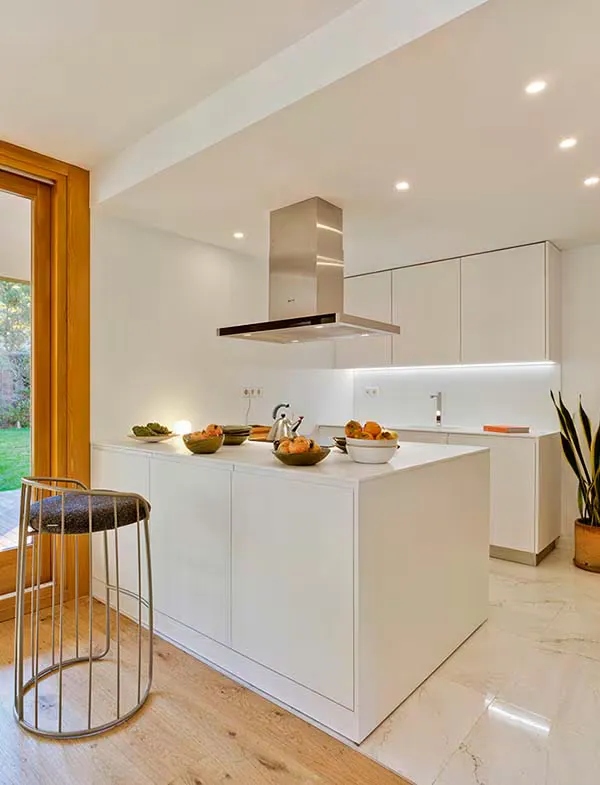
The galley kitchen does not have to be entirely enclosed within two facing walls. The layout can also be achieved using a half wall or an island within an open plan area. Storage is more restricted, but the space feels less claustrophobic. Although only one side of the kitchen will have wall cabinets, sufficient storage can be achieved with floor-to-ceiling pantry units and clever planning. Here are a few more suggestions to help you make the most of your galley kitchen.
Small galley kitchen ideas on a budget
The ‘holy grail’ with the galley kitchen is to make it look and feel larger. This can be done on a restricted budget in a variety of ways.
- Instead of wall cabinets on both sides of the kitchen, use floating shelving on one wall instead.
- Choose a quality floor tile, one that compliments the other design elements.
- For the backsplash, use mirrored or reflective tiles. Not only will there be more light, but the kitchen gets a designer feature.
- Add as much extra storage as you can with simple items such as spice racks, hanging rails, pot and pan hooks, and so on. Order is vital in a well-designed galley kitchen.
- Colour is another sure-fire way to heighten the sense of space. You don’t have to go with white; lighter shades, greys and off-whites will work just as well.
Small narrow galley kitchen ideas
There’s no need to compromise on kitchen décor with the galley layout. The following ideas will help you create a stylish and practical working kitchen:
- Try to plan an equilateral triangle between sink, cooker and fridge. Group the refrigerator and one other device on the same wall. This helps with use efficiency.
- Ensure that the fridge door is hinged on the external side of the work triangle.
- Place the sink beneath an external window (if available) to take advantage of natural light.
- Integrated appliances will work best in the galley kitchen because they look less imposing.
- Lighting the worktop properly is critical to the practical use of the galley kitchen. Use ceiling mounted spotlights and under wall cabinet lighting where possible.
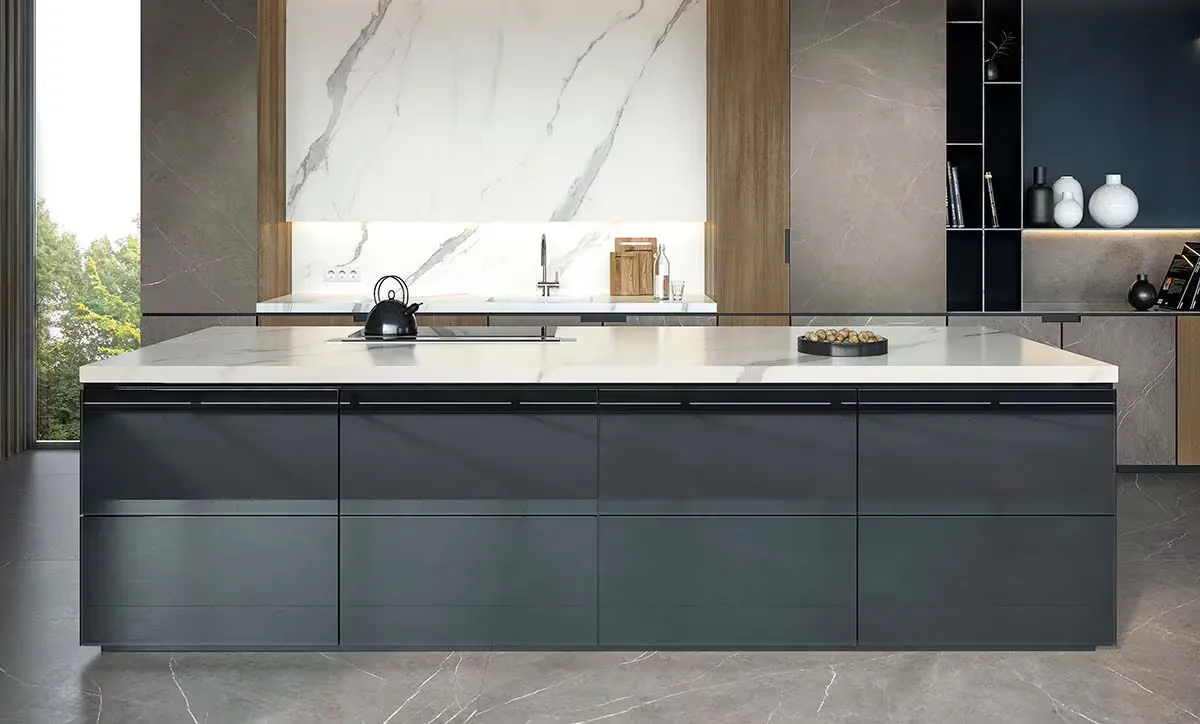
Galley kitchen with island
With an island layout, you can benefit from all the advantages of the galley kitchen without the claustrophobia. Storage and high-level appliances are arranged against the back wall.
The important working triangle relationship is maintained however, which is highly efficient in use. Meanwhile, the island provides a sense of openness and doubles as a breakfast bar or informal dining area, with stools for seating.
FAQs regarding galley kitchens
Where is a galley kitchen recommended?
Where is a galley kitchen recommended?
Depending on the floor plan configuration, the galley kitchen meets all of the requirements of a contemporary kitchen while taking up the least amount of space. In practice, the galley kitchen is best suited for small households and two-story homes (or duplexes) with limited floor space.
What is the minimum distance necessary between floor cabinets/worktops?
What is the minimum distance necessary between floor cabinets/worktops?
The minimum distance between base cabinets is 3 ft (or 90 cm). However, if the kitchen is used by more than one person, a width of 4 to 5 feet is recommended (120 cm - 150 cm). This allows for a better flow and working conditions.
What is the best, most practical way to organise a small galley kitchen?
What is the best, most practical way to organise a small galley kitchen?
- Allow for two access points at either end of the galley kitchen.
- Make sure the fridge, cooker and sink form a work triangle and are close to one another.
- Install a resistant, quality floor tile.
- Maximise the light from available windows, colour choices and artificial sources.
- Keep work surfaces clutter-free.
What are the typical kitchen layouts?
What are the typical kitchen layouts?
The following are the five most common kitchen layouts:
- Linear kitchen, where cabinets etc. are organised in one linear stretch
- L shaped kitchen, where the leg of the L can be free-standing or another wall
- U shaped kitchen, with a continuous worktop along three sides
- G shaped kitchen, with a return peninsula
- Galley kitchen, with a corridor layout
What colour scheme works well for the galley kitchen?
What colour scheme works well for the galley kitchen?
A neutral, bright and reflective colour scheme will help compensate for the reduced size of the galley kitchen dimensions. The cabinets, walls and worktop colour palette contributes to the sense of space. Choose a light-coloured stone or composite to reflect as much light back into the space as possible from the worktop.
1. E6.70 Roble Alba, E3.70 Gris Carbono Gosh
2. E7.90 Roble Cuero, E4.90 Limo Mate