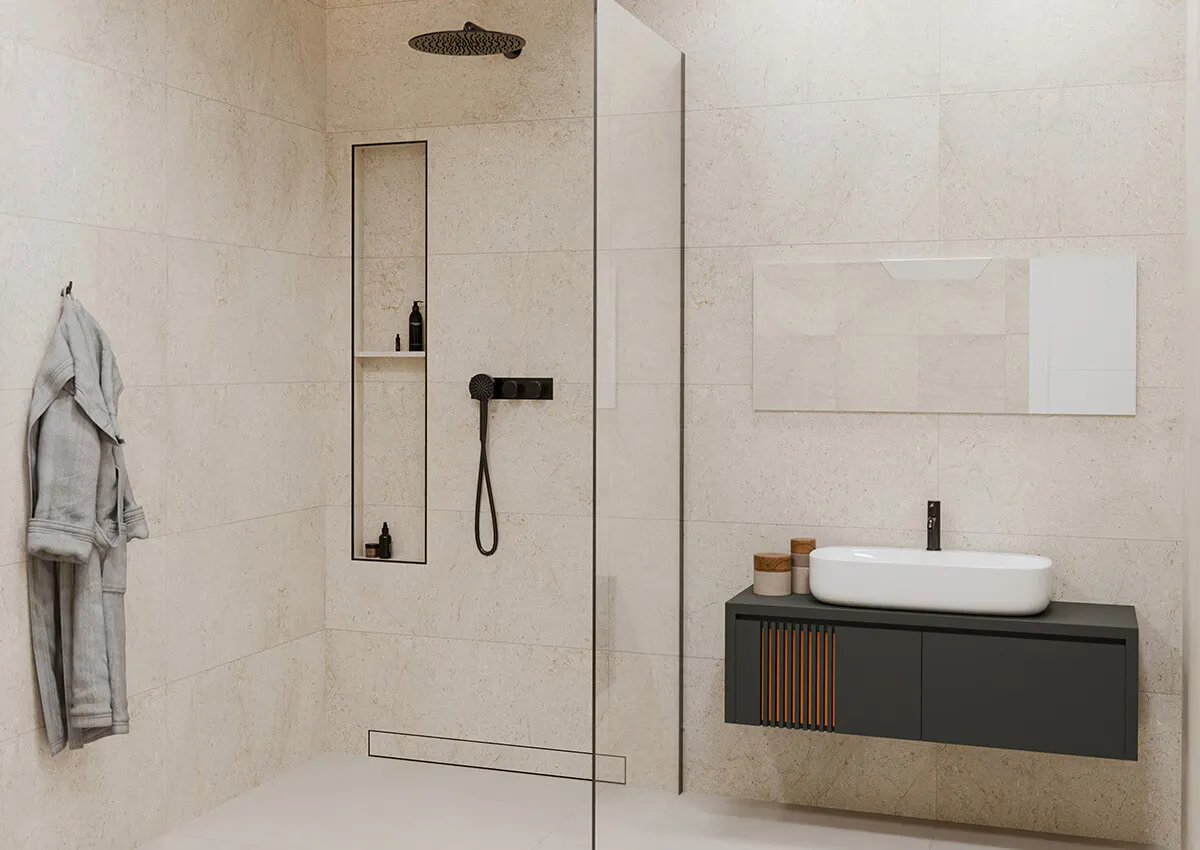
Our Complete Guide to Wet Room Flooring
The stylish looks and practical convenience of wet-room flooring are radically changing how we think about modern bathrooms. Technical advances in waterproofing and level access shower enclosures take bathrooms into a new, seamless design era.
Wet rooms are one of the most innovative space-saving advances in home layouts. Small spaces which hitherto could not accommodate a shower can now be fully functional shower rooms. By removing bulky shower trays, small bathrooms feel more spacious. Furthermore, there are significant advantages in terms of mobility by removing the shower tray upstand. There are fewer trip hazards for users of wheelchairs and walkers. This is going to be an increasingly important feature of lifetime housing.
Wet room flooring is the key to unlocking the potential of small and large bathroom spaces. Through this article, we are going to answer your technical questions in an easy-to-follow manner. And provide some stylish inspiration for different options in floor finishes.
Wet room flooring Bremen Nut Antislip 19×120 cm
How to Waterproof Wet Room Flooring
The basic principle behind wet room flooring depends on the seamless integration of the shower and the bathroom floor. To avoid leaks and moisture damage, water must drain away efficiently, and most importantly, the flooring and walls must have a waterproof seal. The standard approach is to provide a waterproof membrane underneath the floor and wall finish, whatever that may be.
Preparation of wet rooms is everything. Follow these steps to ensure the optimum long-term results.
1. The substrate must be structurally sound and clean, free from any substances which would affect the adhesion of the floor and wall finish.
2. The floor surface must be level, except for the walk-in shower area. Use a levelling compound to even out any imperfections and then seal the entire area.
3. Apply either a liquid-applied membrane or a cementitious waterproofing mortar over the substrate. The liquid membrane is applied in two separate coats with a roller or brush. A flexible waterproof tape or fabric is applied around the shower drain, the corners of the bathroom and between the wall and floor junctions after the first coat.
4. If using a liquid membrane, wait until the first coating is dry to the touch. Apply at a right angle to the first coat for added protection.
5. Reinforce any vulnerable joints with the waterproof tape or fabric, making sure to allow for an overlap of 70mm min. to avoid gaps.
6. Make sure that the waterproof membrane or mortar is completely dry before providing the final tiled finish or other.
7. Epoxy grouting is recommended for wet room floor tiling installations.
Wet Room Flooring Water Drainage
After the waterproofing, the next most important element of a wet room floor is the drainage. There are two main approaches: laying the entire bathroom floor on a slope towards a floor drain. Or alternatively, creating a slope within the localised area of the shower enclosure. You need to avoid water pooling, whichever option you choose. Standing water can be a slip hazard and damage floors.
The wet room flooring should be laid to a fall of 1:100 or 6 mm over 30 cm in the direction of a drain. This is imperceptible underfoot but is nevertheless efficient at directing the water towards the drain. There are several suitable options for achieving this gradient depending on the effect you want to create.
- Standard wet room shower tray formers will provide the correct slope towards a point drain. This simple solution is suited to tiled or vinyl finish bathroom floors and can withstand wheelchair access without additional support.
- A thin layer of sand and cement screed can be shaped to create the desired gradient towards a point drain or a linear drain.
- A linear drain can be placed along the centre line of the wet room with a sloping gradient to either side. Or alternatively placed to one side of the wet room with a single slope.
- The concealed drainage system locates the water outlet between the floor and the wall junction. These wall drains provide a seamless effect with visual continuity camouflaged within the tiled wall finish.
Shower Line waterproofing and drainage system
Wet Room Flooring Slip Resistance
You can never take too many precautions in the design and layout of bathrooms. Wet floors combined with hard surfaces are a dangerous combination. Therefore, building regulations nowadays recommend non-slip flooring options. Luckily, there are a number of stylish wet room tile options to choose from.
Nevertheless, non-slip floor tiles are only recommended for areas that are in direct contact with water. Such as shower enclosures or the entire wet room flooring for smaller spaces. There are a number of different rating systems that use different criteria to test the same results.
- R Rating: measures the slip resistance of tiles based on the ramp test. R-Values range from R9 to R13, which represent the angle at which slipping begins to occur. The higher the rating, the more resistant to slipping. The R Rating test is most popular with European tiling manufacturers.
- PTV Rating: simulates the motion of a slipping foot and measures the tile’s ability to resist based on the Coefficient of Friction. Measured as a Pendulum Test Value (PTV 0-100) or Dynamic Coefficient of Friction (DcoF 0-1), a PTV of 36+ or DcoF > 0.36 is the ideal choice for wet room projects.
- Barefoot / ABC Rating: specifically measures barefoot anti-slip ratings for indoor areas such as bathrooms, but also for commercial areas. A is recommended for domestic use while C is recommended for commercial applications.
Wet room flooring Tanzania Almond Antislip 23×150 cm
Wet Room Flooring Material Options
The most important properties for your wet room flooring are durability and waterproofing. Nevertheless, beyond the material characteristics, you will also want something that looks good. Budget is also an important consideration. The most popular options include wet room tiling and continuous flooring options such as resin and micro-cement.
- Porcelain tiles: One of the hardest-wearing and water-resistant options for wet rooms. The higher temperatures and special clays used in its manufacture create a non-porous material with less than 0.5% water absorption.
- Natural Stone: Marble, slate, limestone, and other stone tiles add a luxurious look and feel to wet room flooring. Stone must be sealed to provide water resistance, and some stone tiles require an anti-slip coating.
- Vinyl: Waterproof and slip-resistant vinyl is budget-friendly and available in many different design options. It also feels more comfortable underfoot.
- Resin / Epoxy: Technical improvements in the chemical composition of epoxy and polyurethane make it highly suited to wet room flooring. The resin is applied as a seamless waterproof barrier to moisture with no joints, which helps prevent leaks. The look is continuous and highly contemporary.
- Rubber: Softer underfoot and a good option for families with young children. The rubber comes in non-slip textures as well as numerous colour options.
- Laminate: Similar to vinyl, some laminate floors are suitable for wet areas. The look can recreate timber or stone very convincingly. Water and slip-resistant.
Porcelain Tiles Wet Room Flooring
The unique qualities of porcelain elevate wet room floors. Porcelain tiles combine both contemporary looks and unparalleled resistance to wear and tear. Thanks to its non-porous composition, porcelain offers almost zero moisture absorption. The range of finishes includes authentic timber, stone and even concrete effects. With an exceptional slip resistance rating (PTV ≥36, R11/R12), porcelain also ensures safety on wet floors.
Porcelain is therefore particularly suited to wet room floor tiles and comes in a variety of designs and dimensions. Rectified large-format tiles add a perception of space to a smaller bathroom. Porcelain mosaic tiles, on the other hand, can be formed into the desired slope to ensure optimal drainage.
Natural Stone in Wet Rooms
Over recent years, natural materials such as stone tiles have been trending in bathroom design. Natural stone is unmistakable, the look, the texture and the quality of granite, limestone, marble, etc., add an elegant sophistication to wet room flooring. Some stones, such as slate, even have natural anti-slip properties. Nevertheless, stone is a porous material; sandstone and limestone are the most porous, while marble and travertine offer medium water absorption. Therefore, these stone tiles require sealing on a regular basis to prevent staining from cleaning products and water absorption.
On the other hand, some stone tiles with a natural, unpolished and textured surface provide superior grip under bare feet. But, as with any natural material, these tiles will require more regular maintenance than porcelain tiles, for example.
Ascot Arce 19.3/29.4×120 cm
How to Design a Wet Room, Ideas & Inspiration
The modern era of interior design is inspired by simplicity and making life easier. The wet room bathroom is a perfect example; its minimalist décor is supported by advances in technology and modern plumbing. The look is seamless with no awkward corners where dirt can accumulate. Maintenance is easier, and there is a Zen-like ambience that recalls a getaway professional spa.
The wet room approach is suited to large and small spaces. Some bathroom layouts work better with a glass screen to protect the other artefacts from the shower spray. But it’s not strictly necessary, and in some cases, as in smaller bathrooms, the layout works better without a screen. Some of the following ideas will inspire your bathroom layout.
- Fit level access preformed wet room shower trays for a seamless integrated floor drain that creates a continuous bathroom floor surface.
- Choose the same wall tiles to match the wet room flooring tiles for a coordinated aesthetic.
- Thanks to the minimalist décor of the wall and floor surfaces, you can be more expressive with the shower fittings and other bathroom artefacts.
- Porcelain tiles come in an extensive range of designs that provide greater freedom to create customised spaces.
- Create a contrast with a wet room zone within a larger bathroom. Use different tiles to define the wet area.
- Combine an anti-slip version of the same floor tile collection within the shower area that matches the other floor tiles.
- Make a design statement with patterned wet room floor tiles that recreate a traditional bathroom layout and aesthetic.
FAQs regarding choosing the right wet room flooring
What is a wet room?
Any bathroom with a level access waterproof shower area is a wet room. Sometimes there is a shower screen or curtain to separate the shower cubicle proper but it’s not necessarily. The aesthetic is minimalist and designed to be seamless.
Where can a wet room be installed?
With the correct plumbing a wet room can be installed anywhere in the home, on any floor level. Wet rooms are suited to small bathroom spaces, such as minimal size ensuites measuring as little as 2 sq.m. or courtesy bathrooms.
What is the best wet room flooring?
The answer really depends on the preferred décor of the bathroom design. However, all things being equal porcelain tiles provide the best technical solution. Porcelain is nonporous, hard wearing and easy to maintain. And porcelain tiles are available in a wide range of designs.
Is tanking necessary for a wet room?
All wet rooms must be tanked with a waterproof membrane to ensure long term viability. To prevent leaks and water egress over time tank the substrate, add a correctly slopped floor and place the drain accordingly. Tanking is particularly recommended for tiled showers because grouting does not provide sufficient waterproofing.
Can you have underfloor heating in a wet room?
Yes, both types of underfloor heating are compatible with wet rooms, either electrical cable or hot water-based heating systems.
Discover a New Era of Bathroom Design
We have explored how the wet room unlocks the potential of ensuites and small bathroom spaces. Similarly, wet room flooring can transform larger bathrooms to add a spa-like atmosphere. To really appreciate the potential of wet room design, we recommend visiting your nearest Porcelanosa showroom. Meanwhile, just drop us a line with any queries regarding the content of this article.