
Over the centuries, the fireplace has been a constant feature in the organisation of the home. Its treatment reflects the architectural styles of the day, from the humble cottage to the aristocratic mansions of the wealthy.

Over the centuries, the fireplace has been a constant feature in the organisation of the home. Its treatment reflects the architectural styles of the day, from the humble cottage to the aristocratic mansions of the wealthy.
And it’s no different today; the fireplace and its decorative treatment provide a living room with character and visual interest. However, fireplace tiles not only provide a decorative flourish to living room décor, but they also help protect the adjacent walls and flooring. We are going to examine the different design and decorative options available for the tiled fireplace to add the wow factor to your home.
Habana Dark Classico 40×80 cm
Horus Beige Graffiato Home 40×80 cm
No matter what technological advances come along in home heating, there is a timeless quality to the naked flame. It appeals to something deep within every one of us, an ancestral attraction to warmth and a search for security. Nowadays, the burning of coal and timber logs has been replaced with gas, ethanol and electrically powered variations. Nevertheless, the principle remains unchanged; we are still drawn to the look of the open flame.
While there are a number of contemporary treatments for the fireplace, it is hard to improve upon stone and ceramic tiles. The fireplace tile surround adds a singular quality not just to the space but to the ambience; it’s a focal point for family gatherings and rituals. Therefore, tiling the fireplace with quality, hard-wearing wall tiles that protect the surrounding areas is recommended. The sheer range of tiles available nowadays ensures that no two fireplaces need to be the same.
UK Building Regulations require a fireproof finish to extend 50cm in front of the fireplace (heat-producing appliance) hearth and 15cm on each side of the fireplace opening. Additionally, fireplace recesses and flues have their own separate requirements. Fireplace hearth tiles thus protect timber floors and rugs from the heat.
Walls adjacent to heat-producing appliances must be clad with fire-rated finishes to a height of 30cm above the appliance. Similarly, to the hearth, fireproof cladding is required 15cm on either side of the appliance on the adjacent walls.
MOSAICO NANTES CALIZA
Credits: ©surroundingsbymaryarthur
The standard fireplace design is made up of three different components, which serve different functions. They might look somewhat different nowadays than during the past, but they are still recognisable. The firebox is the part which contains the heat-generating fuel, and the hearth describes the flooring area directly in front of the firebox. While the mantelpiece is a decorative shelf that frames the top of the fireplace, raised above the firebox.
Traditionally, the fireplace would have been used for preparing food, generating heat and as a hub for gathering. It would have typically been found in the kitchen area. In grander homes, the fireplace provided warmth and was celebrated with ostentatious sculptural mantelpiece surrounds. Nowadays, the fireplace occupies a central location in living rooms; typically placed symmetrically along the main axis of the room.
Although the same basic elements of the fireplace have not changed, the move away from burning fossil fuels provides much greater design freedom. Thanks to natural stone and porcelain fireplace tiles, you can recreate a rustic cottage-core look or a cutting-edge contemporary installation. As well as everything in between. Tiles for fireplace designs provide both security and creativity to add a timeless feature to your home.

Credits: ©timjacksoncustomhomes
The timeless look of the fireplace adds a reassuring decorative element to our hectic lives. There is comfort in the knowledge that, despite all the changes happening around us, at least one part of the home remains the same.
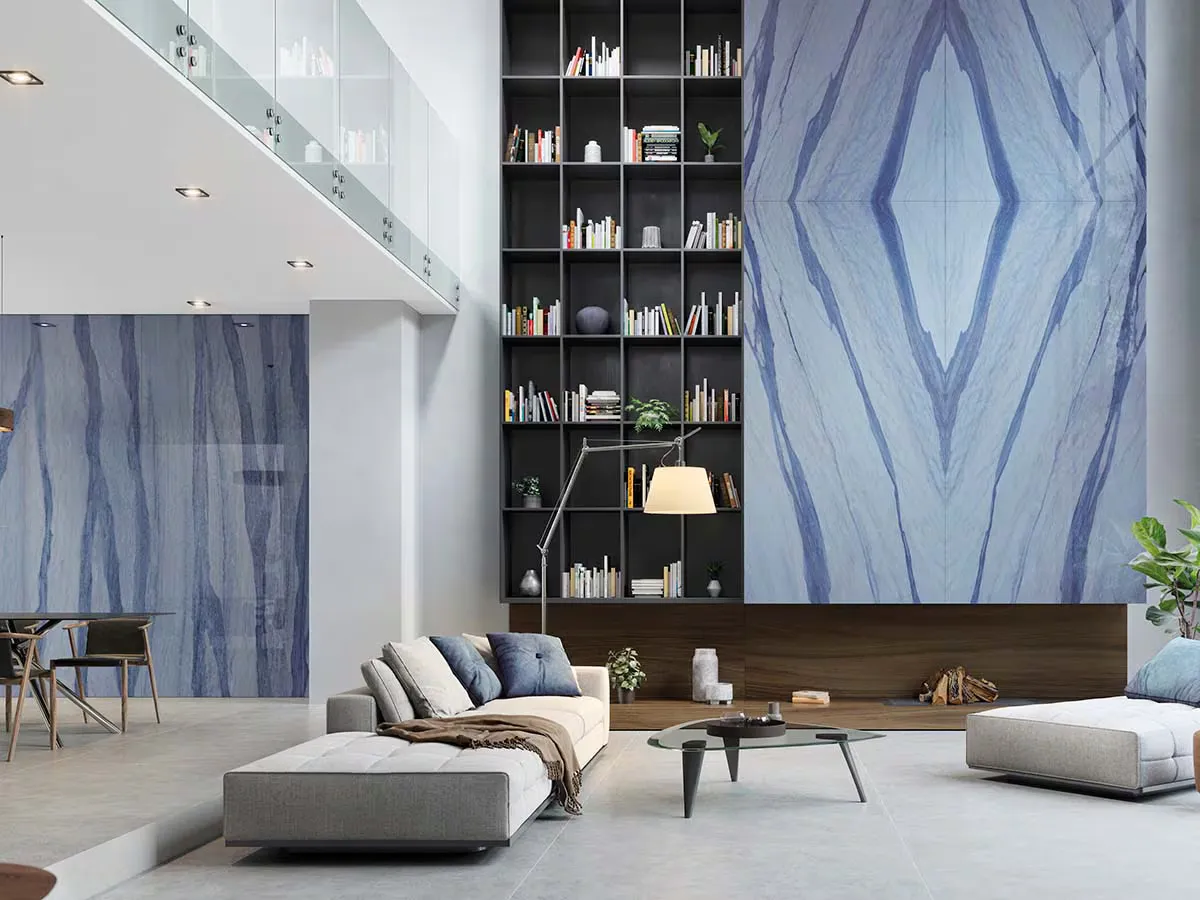
Blue Macaubas Bookmatch 160×300 cm
Bring your fireplace into the 21st Century with cutting-edge fireplace tiles and sculptural looks. The living room is where we gather to unwind and socialise, and a modern fireplace is the perfect focal point to add a custom feature to the room décor.
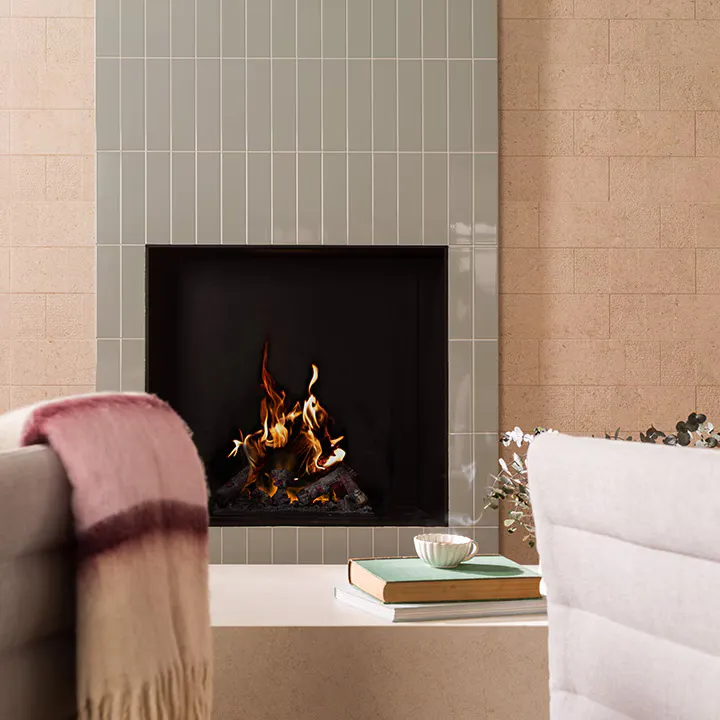
Whether your preference is for small-format decorative Victorian fireplace tiles or modern large-format porcelain tiles, we have you covered. The variety of tiled fireplace ideas is as individual as the homeowner. And it’s a great way to stamp a customised flourish on the living room. The fireplace is the perfect excuse to be creative with a time-honoured household fixture.
⋅ Metro tiles: The smaller format linear metro or subway tile is ideal for combining with other fireplace tiles. Clad the interior area of the firebox with a herringbone pattern tile as a contrast to the chimney breast. Or clad the chimney breast with a vertical metro tile to emphasise its verticality in a low ceiling room.
⋅ Stone fireplace tiles: Match natural stone fireplace tiles with the same tiles for the hearth to create a timeless feature. Choose between different types of stone and finishes, including polished, honed or bush-hammered for a more textured look. Some stone options, like granite, add a decorative patina to complement the crackling flame of an open fire.
⋅ Split-face tiles: Combine the organic weight of stone with the rugged texture of cut stone to make a statement fireplace. Linear split-face tiles in marked layers provide an unmistakable tactile quality. Contrast with other finishes and textures for the best results.
⋅ Large-format tiles: For a more continuous and highly contemporary fireplace installation, choose large-format porcelain tiles. These fireplace tiles are best suited to large open-plan living rooms. Clad an entire wall or create a feature with classic marble effect or modern concrete effect porcelain tiles.
⋅ Mosaic fireplace tiles: Make an artistic statement with a colourful mosaic installation as a focal point within your living room. Choose between small geometric tiles or patterned tiles that recall the Victorian era. Pair with a neutral mantlepiece and hearth to highlight the mosaic tiles.
⋅ Metallic effect tiles: Bring a sparkle to the fireplace surround with a metallic finish fireplace tile. These decorative tiles with reflective qualities add a unique lighting ambience, especially in a room with scattered light sources. The fire and the reflected light create an ambience that is perfect for catching up with your favourite TV shows or just winding down.
⋅ Timber effect tiles: One of the most popular choices for the design of the mantlepiece is natural wood. The organic warmth of wood adds a cosy touch even without the flames. Porcelain timber-effect fireplace tiles make an ideal frame for the fireplace with all the advantages of a non-combustible finish.
⋅ Textured fireplace tiles: 3-D tiles are becoming more popular as fireplace tiles. The range of textures and patterns provides an inspirational choice in creativity. Contrast the texture of the fireplace surround with a plain hearth tile or mantelpiece. The look adds drama to the room, and with modern fireplaces, there is no soot to worry about.
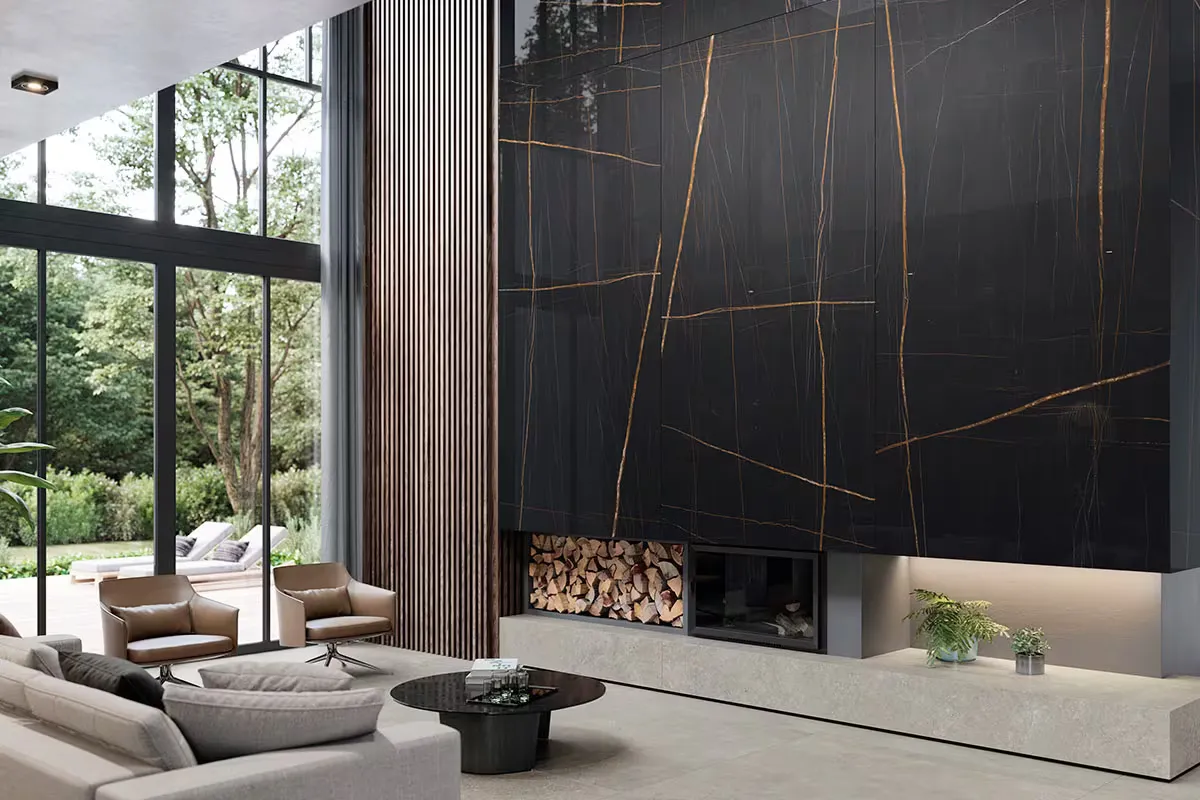
Nylo Noir Polished 160×320 cm
The area in front of the open fireplace is known as the hearth, a word that is synonymous with the word for home in many cultures. Hearth tiles protect the surrounding floor finishes from overheating and stray projectiles from a fossil fuel fire. Nowadays, however, there is a trend to treat the hearth as a practical shelf that runs the entire length of the fireplace. This suits the raised fireplace, placing the shelf at a practical height off the floor to keep decorative objects.
Fireplace heart tiles can match the cladding of the chimney breast, or alternatively, the tiled hearth can create a total contrast. This trend blends the best of traditional design with modern convenience and is particularly recommended for gas and ethanol fireplaces. Porcelain tiles offer the optimum non-combustible protection.
To discover the full potential of fireplace tiles to transform your living room, we recommend making an appointment with your nearest Porcelanosa showroom. Staff there are on hand to explain the relevant building regulations in your area and show you the range of possibilities. In the meantime, if you have any questions regarding the content of this article, please contact us. We’ll be happy to get back to you.
Tiling around fireplaces requires specialised skills. As a result, there are many questions about what tiles and materials to use, and how to meet quality standards. Here we look at tips and recommendations about fireplace tiles.
Either stone or porcelain tiles are recommended for cladding fireplace surrounds. Stone is naturally resistant to heat; most varieties are non-combustible and withstand high temperatures. Granite and quartzite are the among the most resilient while marble is prone to thermal shock. Porcelain on the other hand is fired at very high temperatures and is suitable for use in close proximity to heat producing appliances. Marble effect tiles are therefore preferable.
No. Although ceramic and porcelain tiles are non-combustible materials, classified as Euroclass A1 under EN 13501-1, they are not designed to withstand direct exposure to flame or extreme heat. For this reason, international building standards — including EN 1443:2022 (Europe) and IRC 2021, Section R1001 (USA) — specify that the firebox must be constructed using refractory firebricks and mortars capable of resisting temperatures above 600 °C. Tiles can, however, be safely used on the exterior surfaces of a fireplace — such as the surround, hearth extension, or chimney breast — where they perform exceptionally well thanks to their A1 non-combustibility and durability, provided they are fixed with heat-resistant adhesives compliant with EN 12004.
Yes, you can tile over most common construction materials. But preparation is everything. Make sure the brick or stone is in good repair, use mortar to create a level backing. Or alternatively cover the existing fireplace with a backer board if necessary. The important step is to have a clean and flat base for the new fireplace tiles. Choose a fire-resistant material for longer lasting results.
The first step is to remove any soot or dust with a soft brush or vacuum cleaner. Mix a mild detergent such as washing up liquid with warm water and apply with a damp cloth. For more stubborn stains let the detergent sit for a few minutes before scrubbing gently. Rinse the tiles thoroughly with clean water and dry with a microfibre cloth. Mix equal parts water and hydrogen peroxide for grout lines, apply with a toothbrush and scour lightly. Remove any excess solution and dry thoroughly.