
From internal management to product development, Porcelanosa applies international standards that ensure quality, sustainability, and safety in each of its materials and processes.
Porcelanosa operates under internationally recognised management systems that ensure consistency, traceability and continuous improvement across all areas of the business. These certifications support a structured approach to quality, environmental responsibility and energy efficiency, reinforcing a long-term commitment to responsible manufacturing and operational excellence.
At a corporate level, Porcelanosa implements integrated management systems that optimise internal processes, reduce environmental impact and improve energy performance. These certifications guarantee that every stage, from production to distribution, is managed according to internationally recognised standards.
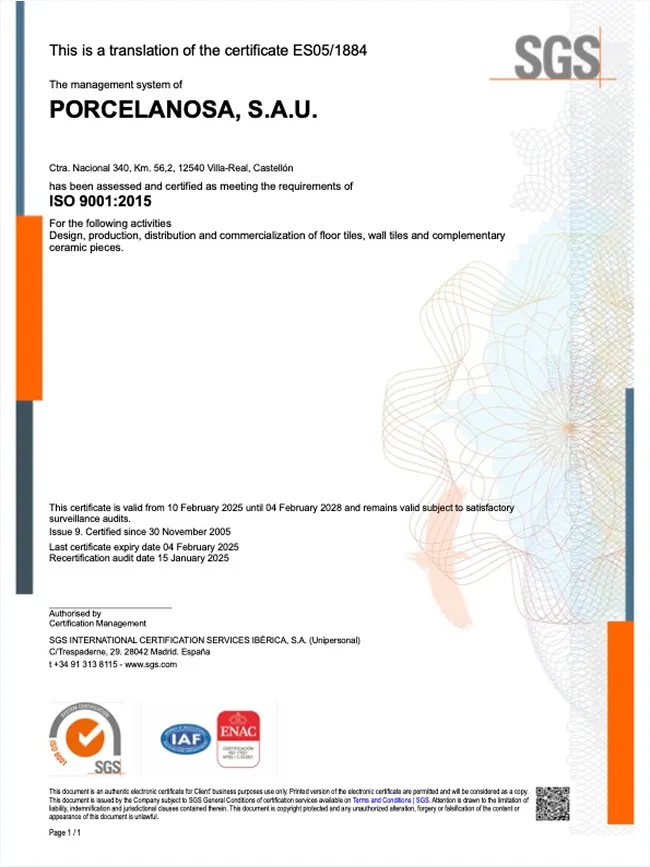
Quality Management System. Ensures consistent product quality through structured processes focused on efficiency, traceability and customer satisfaction.
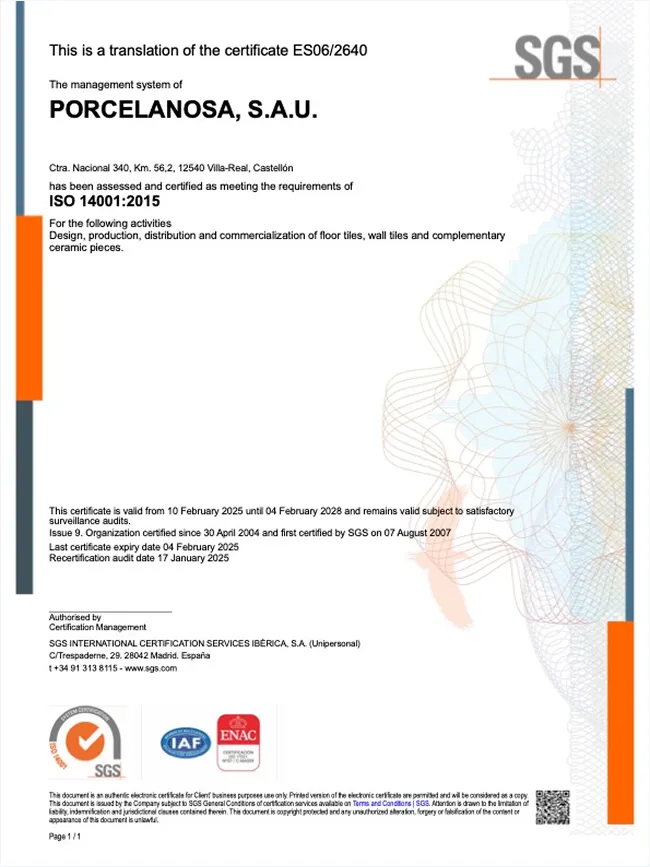
Environmental Management System. Supports the control and reduction of environmental impact across operations through structured environmental management and continuous improvement.
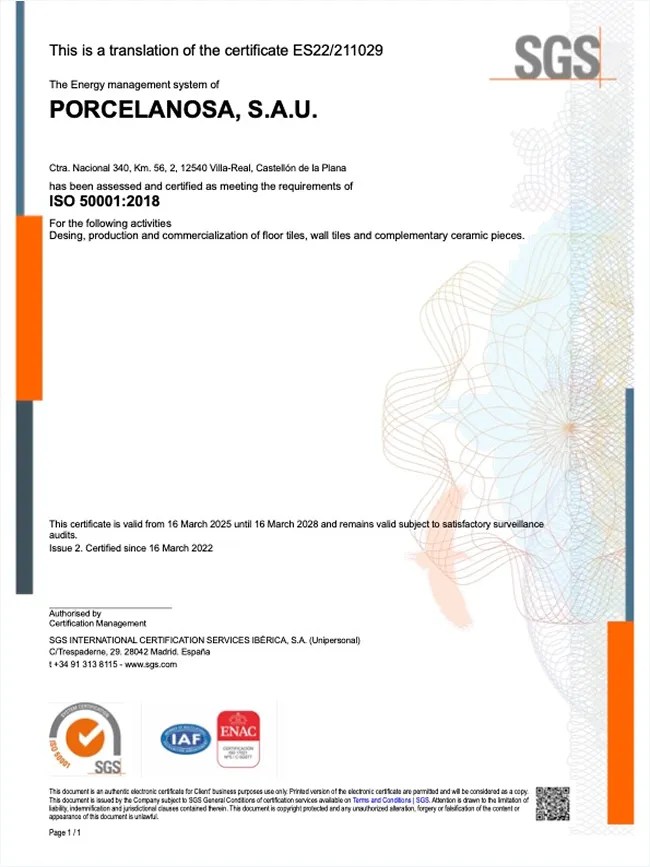
Energy Management System. Promotes efficient energy use through monitoring, optimisation and continuous improvement across production and operational processes.
Authorised Economic Operator. Recognises secure and reliable international trade practices, customs compliance and trusted supply chain management.
Where available, certification documents can be consulted and downloaded below.
Sustainability is integrated into Porcelanosa’s production model through the responsible management of resources, reduction of emissions and development of environmentally conscious materials. This approach is supported by certifications that address both corporate performance and product lifecycle impact.
At company level, Porcelanosa implements environmental control systems that measure and reduce its impact, ensuring efficient use of resources and responsible waste management aligned with circular economy principles.
Waste management certification. Verifies that generated waste is handled through reuse, recycling or recovery processes in line with circular economy principles.
Greenhouse gas (GHG) verification. Confirms the measurement of emissions associated with company activity and supports reduction and management strategies.
Product-level certifications provide transparency on environmental performance, evaluating materials throughout their lifecycle and ensuring compliance with international sustainability standards.
Type II environmental label. Verifies self-declared environmental claims and supports transparent communication of product sustainability attributes.
Environmental Product Declaration. Provides independently verified data on a product’s environmental impact throughout its life cycle under ISO 14025.
French environmental and health declaration. Provides life-cycle environmental data under the French standard NF EN 15804+A2 for construction products.
Type I environmental label. Identifies products with a reduced environmental impact within their category under ISO 14024 criteria.
Leadership in Energy and Environmental Design. Building sustainability certification. Supports projects through verified data on materials, resources and environmental performance.
Building Research Establishment Environmental Assessment Method. A widely used European standard that evaluates the environmental impact of buildings, efficiency, health and responsible sourcing.

Spanish sustainability certification developed by Green Building Council España. Assesses the environmental impact of buildings throughout their lifecycle.
Technical safety documentation. Provides information on composition, handling and safe use for ceramic tiles and XTONE or XLIGHT products.

European chemical compliance regulation. Confirms the absence of SVHC substances, or their presence below the 0.1% threshold established by the regulation.
Where available, certification documents can be consulted and downloaded below.
Porcelanosa products comply with a wide range of international technical standards, ensuring performance, safety and suitability across different markets and applications. These certifications validate the behaviour of materials under real conditions of use and guarantee their compliance with regulatory requirements worldwide.
Porcelain tiles are tested and certified to meet strict performance criteria, ensuring durability, resistance and suitability for a wide range of applications.

Chinese conformity certification. Classifies porcelain flooring products according to natural radionuclide emissions under GB6566 Class A requirements.
French flooring classification system. Assesses suitability for use based on wear, mechanical resistance, water resistance and chemical resistance.
Wall tiles are certified to ensure their performance in interior vertical applications, meeting technical requirements related to durability, adhesion and long-term stability.

French certification for ceramic wall tiles. Confirms suitability for interior wall applications in accordance with CSTB (Scientific and Technical Centre for Building) technical requirements.
Products intended for both flooring and wall applications comply with international standards that regulate their commercialisation and use across global markets, ensuring technical reliability and regulatory compliance.
In addition, Porcelanosa undergoes regular product audits based on ISO 9001 standards across multiple international markets, reinforcing consistent quality control worldwide.
International product audits
France, Indonesia, Iraq, Kurdistan, Kuwait, Malaysia, Mozambique, Nigeria, Tanzania, Thailand, Uganda, Belarus, United Kingdom, Croatia and the United States.
Saudi conformity certification. Required for ceramic tile exports to Saudi Arabia under national standards for quality, safety and compliance (Saudi Standards, Metrology and Quality Organization).
European conformity marking. Confirms that products meet EU requirements for safety, health, performance and regulatory compliance.

United Kingdom conformity marking. Confirms compliance with product regulations applicable in Great Britain for market placement and use.
